Dental implants for seniors are often possible, but age is not the question that decides treatment. The useful questions are about bone, medications, healing, daily care, and whether a fixed or removable replacement fits the way you eat and live. Celebrity Smiles in West Melbourne reviews those factors with Dr. Anand Shah, DMD, after an in-person exam. This guide is for the conversation, not a diagnosis.
Request an Appointment at Celebrity Smiles Melbourne
What should seniors ask before dental implants?
Walk into the visit with a short list, not a stack of printouts. The goal is to leave knowing what is being replaced, what the scan showed, and what would make the dentist wait. A good answer names a finding. A weak answer only repeats that implants are popular.
- Ask which teeth the plan replaces, and whether the result is one crown, a bridge, or a full arch.
- Ask what the 3D scan shows about bone, nerves, and sinuses at each site.
- Ask how your medicines and medical history change healing or timing.
- Ask what you will wear, eat, and clean during healing, and who can help if your hands are stiff.
- Ask what finding would delay treatment or point to a different option.
Write the answers down before you decide. If a point is still unclear, that is a reason to schedule a second conversation, not a reason to guess. Families who help with rides or daily care should hear the same explanation.
Is age the factor that rules dental implants for seniors out?
Start with the question most families ask first: can an older adult still be a candidate? A consensus review from the International Team for Implantology found that advanced age alone, including age 75 and older, is not a contraindication for implant therapy. The same review reported that bone changes around implants in geriatric patients were similar to other age groups over one to five years of follow-up.
That finding does not mean every older adult should proceed. The same group of statements says patients with medical conditions need an individual risk review. Heart disease, a past stroke, and high blood pressure did not, by themselves, show worse implant survival in the studies the panel cited. Cancer treatment is different. Radiotherapy to the head and neck can affect implant survival, and high-dose antiresorptive therapy used for cancer that has spread to bone is described as a reason not to place implants.
The ADA’s MouthHealthy implant page makes the same point in patient language. It says health is more of a factor than age. It also notes that chronic illnesses such as diabetes or leukemia may interfere with healing, and that tobacco can slow healing. A physician may be asked to review your health before surgery is scheduled. Bring a current medication list, the name of each physician, and any history of radiation, chemotherapy, or osteoporosis treatment.
Ask the dentist which of those facts would change the plan, and which would only change the timing. A birthday is a poor screening tool. Healing capacity, bone, and the ability to keep the area clean are the points that matter. If you use a walker, need a driver, or recover slowly from other procedures, say that too. The plan should fit the week after surgery, not only the hour in the chair.
What should the bone and imaging review cover?
An implant needs bone that can hold a titanium post. Years without a tooth, or years in a denture, can leave less bone than a person expects. Ask whether the scan shows enough height and width, and whether a graft would be discussed before placement. Also ask how nerves and sinuses sit relative to the planned sites. Those landmarks decide where a post can go.
The dental implants page describes how Celebrity Smiles uses CBCT 3D imaging to see bone, nerves, and sinuses before planning. Digital intraoral scanning creates a model of the teeth and gums without a traditional impression tray. Ask to see the scan with the plan, not only a verbal summary. A clear view makes it easier to understand why one site is suitable and another is not.
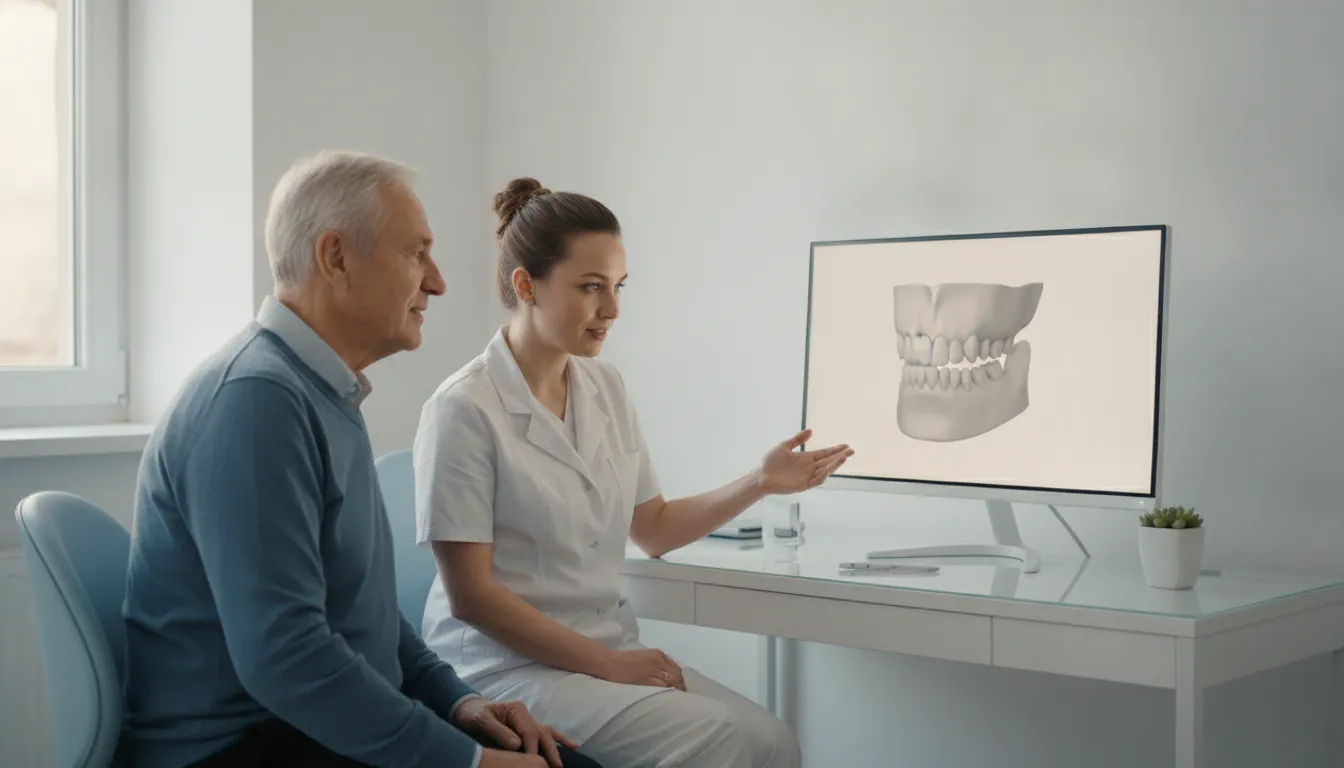
If grafting is mentioned, ask what the graft is meant to do, how long healing may take, and whether treatment can still move forward if grafting is declined. Ask whether a shorter or angled post is being considered, and what tradeoff that choice carries. None of those answers can be settled from a photo or a phone description. They come from the exam and the scan.
Bone is not the only image question. Ask whether gum tissue is thick enough to cover the post, and whether infection or a failing tooth has to be treated first. A site that looks fine in the mirror can still be a poor place to put an implant until the gum is calm. That sequencing is part of a careful plan for dental implants for seniors, especially when several teeth are involved.
Which health conditions and medicines belong on the list?
Ask for a plain explanation of how your health history would be weighed. Diabetes control, dry mouth, gum inflammation, and smoking history can all change healing. So can medicines that affect bone. The American Dental Association notes that this rare jaw complication is uncommon with the doses of bisphosphonates and denosumab used for osteoporosis. It is more of a concern at the higher doses used for some cancers. Risk is also higher after more than two years of treatment, and in people with gum disease or dentures.
Do not stop an osteoporosis medicine because you are considering an implant. The ADA points out that the harm of an osteoporosis-related fracture is considerable. The low risk of this jaw complication does not outweigh treatment for people taking these drugs for osteoporosis. The right step is to tell both the dentist and the prescribing physician, then let them coordinate. Ask what warning signs after surgery would need a same-day call, such as pain that worsens, swelling that spreads, or an area of bone that stays exposed.
Blood thinners, steroids, and medicines that dry the mouth deserve the same honesty. Ask whether a dose needs to change, or whether the physician only needs a note. Never adjust a prescription from an article. Sedation is a separate question. The practice offers nitrous oxide and oral sedation for patients who feel anxious, and Dr. Shah’s provider profile lists conscious sedation among his certifications. Ask which option, if any, fits your medicines and who monitors you. Sedation does not make someone a candidate. It only changes how the visit feels if treatment is appropriate.
If you have had cancer treatment, ask that question directly. Head and neck radiation is not the same as a medicine taken for bone density. The implantology consensus treats high-dose antiresorptive therapy for cancer that has spread to bone as a reason not to place implants. Ordinary osteoporosis care is a discussion, not an automatic no. Getting those two histories mixed up leads to bad decisions in both directions.
What questions separate a real plan from a sales visit?
Use the consultation to pin down decisions, not slogans. A useful visit should leave you with written answers you can compare at home. If the answer to any row below is “we will see,” ask when that answer will be known and what has to happen first.
| Question to ask | Why it matters | What a clear answer includes |
|---|---|---|
| What problem are we solving? | One missing tooth and a loose full denture are different treatments. | The teeth involved, and whether the plan is a single crown, a bridge, or a full arch. |
| What does the scan show? | Bone, nerves, and sinuses set the limits. | Whether sites are ready, need grafting, or are not suitable. |
| How do my medicines affect this? | Bone drugs, blood thinners, and cancer treatment can change risk. | Which physician will be consulted, and whether timing should change. |
| What will I wear while I heal? | Some people need a temporary tooth or denture. Others do not. | Whether a temporary is planned, and what eating limits apply. |
| How do I clean it every day? | A plan you cannot maintain is a poor plan. | Brushing, flossing or a water flosser, and how often you return. |
| What would make us wait or stop? | Consent includes the reasons not to proceed. | The findings that would delay treatment or point to another option. |
Ask for the timeline in stages. Placement, healing while the post joins the bone, and the final tooth or denture are separate steps. The implant page notes that healing often takes a few months and that grafting changes the schedule. MouthHealthy describes the same three phases: placement, bone healing, and the custom tooth, bridge, or denture. Some patients can receive replacement teeth sooner. Others need to wait until the bone has joined the post. Immediate teeth are sometimes discussed for fixed full-arch treatment, but that is a case-by-case decision, not a promise.
Also ask how you will get home, what you can eat that night, and when the next check is. A plan that ignores the first week is incomplete. If a family member will help with medicines or meals, invite that person to hear the instructions. Details get lost when they are repeated from memory in the car.
How do fixed and removable choices differ for older adults?
When several teeth or a full arch is missing, the choice is not only implants or dentures. Ask which teeth are fixed in place and which can be removed for cleaning. A single implant replaces one tooth and leaves the neighbors untouched, unlike a traditional bridge. An implant-supported bridge replaces several teeth in a row. A full-arch plan may use about four to six implants to hold a fixed set of teeth, or fewer implants to steady a denture that still comes out.
Celebrity Smiles also discusses Locator Fixed full-arch treatment. That option is tapped or snapped onto the implants rather than screwed in the traditional way. Ask how the prosthesis is removed for professional care, who removes it, and what daily cleaning looks like at the sink. Those details matter more than a brand name. A design that is easy for the dentist to service still has to be workable for you at home.
If a removable denture is still on the table, compare it with an implant-supported denture. Anchoring a denture to implants can reduce slipping and the need for adhesive, but it still requires the denture to be cleaned outside the mouth. People who have trouble with small brush motions, or who rely on a caregiver, should say so before choosing a design that is hard to reach. The comparison with a conventional denture is covered on the implants versus dentures page, so this visit can stay on the questions that change your own plan.
Ask what happens if one post cannot be placed where the drawing showed it. A careful full-arch plan has a backup: a different number of posts, a graft, or a removable design. Hearing that backup before surgery is more useful than hearing a best-case story. It is also fair to ask which choice Dr. Shah would not offer you, and why.
What does maintenance look like after the new teeth are in?
Implants are cleaned, not ignored. Ask which brush, floss, or water flosser the office recommends for the design you are considering, and whether a caregiver can do that cleaning if your hands are stiff. Also ask how often the prosthesis itself needs to be checked. A fixed bridge can hide plaque where a toothbrush does not reach. A removable denture can collect debris on its fitting surface.
The practice’s guidance on how long dental implants last is the right companion to this conversation. Longevity depends on home care, gum health, and follow-up visits, not on a guarantee. MouthHealthy describes an implant as a post placed in the jaw to anchor replacement teeth, and it points readers back to a dentist for a personal assessment. That is the correct endpoint of an article too.
Before you leave the consult, ask what the first week of eating will look like and which symptoms are routine soreness versus a reason to call. Soft foods are common while the site heals. Fever, spreading swelling, bleeding that will not slow, or a tooth that feels loose are not routine. Celebrity Smiles can be reached at (321) 914-0929. Saturday hours are listed differently across pages, so call before you plan a weekend visit.
Cost and benefits are a different conversation from candidacy. Use the implant cost guide for fee questions and the insurance explainer for what a plan might pay. Coverage depends on the policy. An article cannot tell you that you qualify. If you want the office setting and comfort options rather than this question list, the West Melbourne dentist for seniors guide already covers that overview.
Preparation for the surgical day itself is also its own topic. The implant surgery preparation guide is the place for fasting, escorts, and the night-before list once a plan exists. Do not use that checklist to decide whether you are a candidate. Use it after the exam says treatment is appropriate.
Request an Appointment at Celebrity Smiles Melbourne
FAQ: questions people ask before treatment
Can someone in their 70s or 80s still ask about implants?
Yes. Age by itself is not treated as a reason to say no. Health, bone, medicines, and the ability to clean the area decide whether a plan is reasonable. Only an exam can apply those factors to one person.
Do osteoporosis medicines automatically cancel treatment?
No. Doses used for osteoporosis carry a low risk of a rare jaw complication, while higher cancer doses are a different situation. Tell the dentist and the prescribing physician. Do not stop the medicine on your own.
Will I need a bone graft?
Sometimes. Long-term tooth loss can leave too little bone for a post. A 3D scan shows whether grafting is worth discussing, how it would change the timeline, and whether another design fits the bone you have.
Are full-arch teeth always placed the same day?
No. Some fixed full-arch plans can include a temporary set of teeth soon after surgery, and some cannot. Healing, bite, and bone decide that. It should be stated as a possibility only after the exam.
Who decides if dental implants for seniors are appropriate?
The dentist decides after an exam, a health history, and imaging. Dr. Anand Shah, DMD, plans implant care at Celebrity Smiles in West Melbourne. A web page can help you ask better questions. It cannot clear you for surgery.