When you search for before and after pictures of veneers, it is natural to focus on the final smile. A more useful approach is to study what changed, why the change may have been appropriate, and whether the example resembles your starting point. Photos can help you prepare for a consultation, but they cannot predict your individual result.
Request an appointment to discuss veneer goals at Celebrity Smiles Melbourne
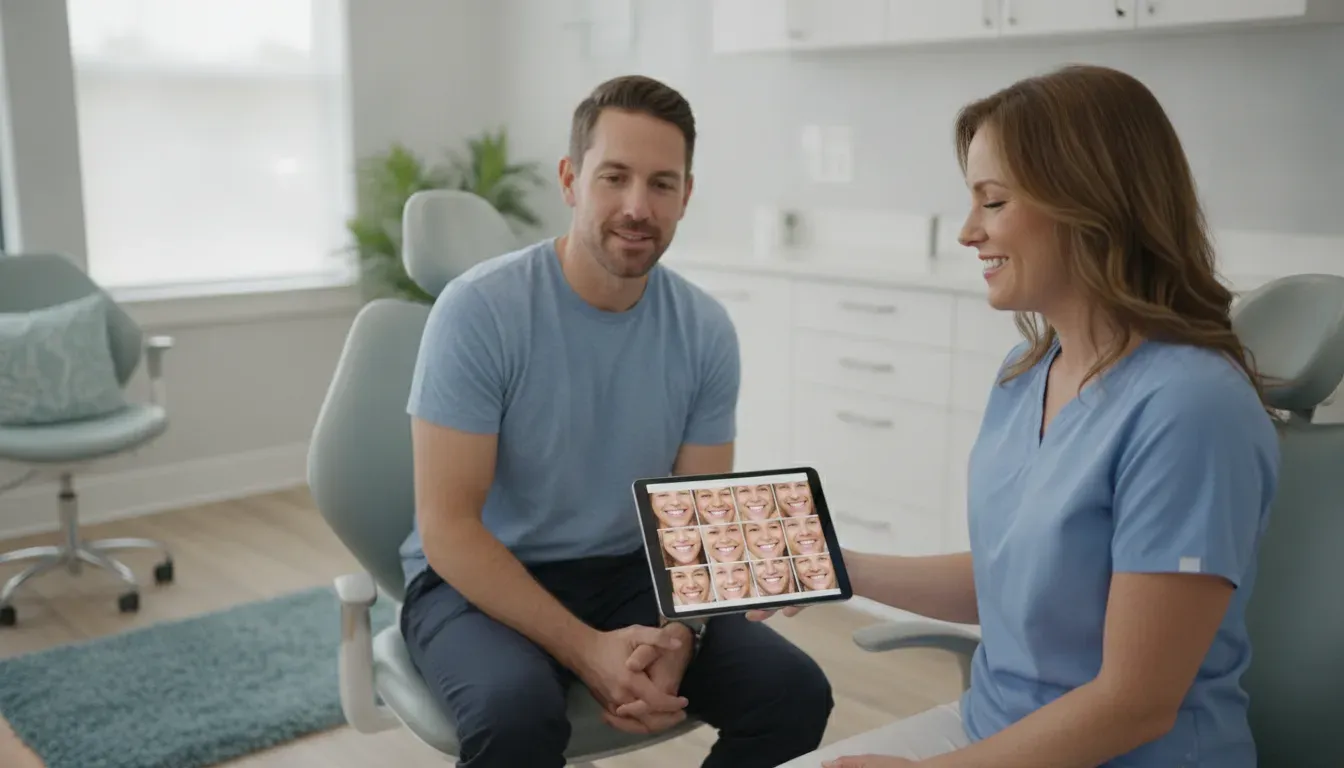
What can veneer before-and-after pictures show?
Veneer before-and-after pictures can illustrate changes in tooth color, shape, size, spacing, chipped edges, and the visible balance of a smile. They show one person’s starting point and outcome, not a guaranteed template. The most useful examples include consistent angles, clear lighting, and enough context to understand what treatment was performed.
Porcelain veneers are thin, custom-made ceramic coverings bonded to the front surfaces of teeth. At Celebrity Smiles Melbourne, Dr. Anand Shah, DMD evaluates the teeth, gums, bite, goals, and available alternatives before recommending any cosmetic treatment. Digital intraoral scanning may support planning when clinically appropriate.
- Color: Whether discoloration was softened or a more even shade was created.
- Shape: How chipped, worn, narrow, or uneven teeth were proportioned.
- Spacing: Whether small gaps appear less noticeable after treatment.
- Smile balance: How the visible teeth relate to the lips, gums, and neighboring teeth.
How should you compare the starting and final photos?
Compare veneer photos by looking beyond brightness. Check whether the camera angle, head position, expression, lighting, and distance are similar. Then compare the starting teeth with the final teeth for proportion, shade, edge shape, gum framing, and the amount of tooth that shows when the person smiles. Consistent photography makes visual comparisons more meaningful.
1. Check the photo conditions
Lighting can make teeth look brighter, while a different angle can change how wide or straight a smile appears. A relaxed smile and a broad posed smile are not equivalent. Look for examples photographed in similar conditions, and ask whether the images were taken at the same distance and with the same type of lighting.
2. Look at tooth proportions and edges
Natural-looking smiles are not defined by identical teeth. Consider whether the central incisors, lateral incisors, and canine teeth have a balanced relationship. Look for edges that follow a gentle smile arc instead of forming a completely flat line. The best design depends on the person’s features and goals, not a single universal tooth shape.
3. Notice the shade and translucency
A bright result is not automatically a better result. Ask whether the shade complements the person’s complexion, age, lips, and untreated teeth. Porcelain can be selected in different shades, but the final plan should account for the appearance of the full smile. If only some teeth are treated, color matching with the remaining teeth becomes especially important.
4. Observe the gum line and smile frame
Gums are part of the smile picture. Uneven gum exposure, swelling, or changes in the gum line can affect how a veneer case appears. A photograph cannot determine whether a gum concern needs treatment or whether veneers are appropriate. An exam is needed to assess oral health before cosmetic planning.
What questions should you ask about veneer examples?
Ask for context before treating a photo as a model for your own smile. A dentist should be able to explain the original concern, the material used, the number of teeth treated, and the planning decisions behind the result. You can also ask how the photographs were taken and what limitations apply to the example.
- Was the example created with porcelain veneers, composite bonding, crowns, whitening, aligners, or a combination?
- How many teeth were treated, and were any teeth outside the visible smile changed?
- Did the starting teeth have similar color, shape, spacing, wear, or alignment concerns?
- What changes were planned for tooth length, width, shade, translucency, and edge position?
- Were the photos taken with comparable lighting, camera settings, angle, and facial expression?
- What maintenance, protection, or follow-up was recommended after treatment?
- Which alternatives were considered before veneers, and why were they or were they not selected?
These questions help separate a useful clinical example from a polished image with too little context. They also keep the conversation focused on your goals rather than on copying another person’s smile.
Which features suggest a natural-looking veneer result?
A natural-looking veneer result usually has variation that resembles healthy enamel rather than a row of identical white blocks. Look for balanced proportions, subtle translucency, smooth but not overly uniform surfaces, and a shade that fits the rest of the face. The goal is a smile that appears harmonious, while the exact design remains personal.
| Feature | What to observe | Question for your consultation |
|---|---|---|
| Tooth shape | Do the edges and corners look balanced with the person’s facial features? | Which shapes would suit my smile goals and existing tooth structure? |
| Shade | Does the brightness look compatible with the surrounding teeth and complexion? | How would different shade options appear in natural light? |
| Gum framing | Does the gum line look healthy and proportionate around the visible teeth? | Do my gums need evaluation before cosmetic treatment? |
| Smile arc | Do the incisal edges follow the curve of the lower lip when smiling? | How will tooth length and edge position affect my smile? |
| Texture and light | Do the surfaces reflect light with some natural variation? | How will the material and finish affect the appearance of my smile? |
A photograph can start a conversation, but it does not replace an examination. Teeth, gums, bite forces, existing restorations, and habits such as clenching can affect treatment planning. A dentist may recommend addressing oral health concerns or considering another option before veneers.
Call (321) 914-0929 or request a veneer consultation in West Melbourne
What can change the appearance of veneer results?
Two people can choose similar veneer goals and still have different-looking results because every smile has different tooth structure, gum contours, facial proportions, and bite relationships. The number of teeth treated, the material, shade selection, photography, and the person’s maintenance routine can all influence how an example looks over time.
Starting conditions matter
A case involving small chips is different from a case involving severe wear, dark underlying discoloration, gaps, or a complex bite. A dentist must evaluate the health and structure of the teeth before discussing whether veneers are suitable. Do not assume that a photo showing one type of concern applies to a different condition.
Digital planning supports discussion, not a promise
Digital scans, photographs, and other planning tools can help a dental team discuss proportions and possible designs. They are useful for communication, but a preview or simulation is not a guarantee of the final result. Dr. Anand Shah, DMD will explain what can reasonably be considered after reviewing your individual smile and oral health.
Photos have limits
Before-and-after photographs may be cropped, color-corrected, taken under different lighting, or selected from a larger set. That does not mean every example is misleading. It means you should ask how the images were created and use them as discussion tools rather than as promises.
How does a consultation turn photos into a realistic plan?
A consultation connects the visual example to your own health, anatomy, and priorities. The dentist reviews your concerns, examines your teeth and gums, discusses alternatives, and explains what changes may be reasonable to consider. This process helps you decide whether veneers, bonding, whitening, aligners, crowns, or no cosmetic treatment best fits your situation.
At Celebrity Smiles Melbourne, patients can discuss cosmetic goals with Dr. Anand Shah, DMD and learn how digital intraoral scanning and other technology may support planning when appropriate. You can also review the practice’s porcelain veneers guide for an overview of treatment considerations, then explore cosmetic dentistry in West Melbourne to compare related services. If preserving more natural tooth structure is a priority, the practice’s composite tooth bonding guide offers another treatment discussion.
Final recommendations require an in-person exam and a personalized treatment plan. Online images cannot determine whether veneers are safe or suitable for you, and no photograph can promise a particular outcome.
Request an appointment to review veneer examples and smile goals with Celebrity Smiles Melbourne
Frequently asked questions about veneer pictures
Do before and after pictures of veneers show exactly what my smile will look like?
No. Pictures show one person’s starting point, treatment plan, photography conditions, and outcome. Your result depends on your teeth, gums, bite, goals, material choices, and personalized planning. Use examples to ask informed questions, not to predict a guaranteed result.
What should I look for in veneer photos?
Compare similar lighting and angles, then look at tooth proportions, shade, translucency, edge position, gum framing, and the overall smile arc. Ask how many teeth were treated and what material or combination of treatments was used.
Can veneers make every smile look brighter and straighter?
Veneers may improve the appearance of certain cosmetic concerns, but they do not correct every oral health or bite issue. Whitening, bonding, aligners, crowns, gum care, or restorative treatment may be considered instead or first, depending on the examination.
Are veneers permanent or reversible?
Porcelain veneer treatment is generally considered irreversible because preparation may involve removing enamel. A dentist should explain the preparation, alternatives, maintenance, and long-term considerations before treatment is recommended.
How do I choose a veneer dentist in West Melbourne?
Look for a licensed dental practice that explains the limits of photographs, evaluates your oral health, discusses alternatives, and creates a plan around your goals. Ask how the team approaches shade, tooth proportions, digital planning, follow-up, and informed consent.
Veneer photos are most valuable when they help you ask better questions. If you are considering cosmetic dentistry in West Melbourne, contact Celebrity Smiles Melbourne to discuss your goals and arrange an in-person evaluation.